This is a second image taken during the yearly one-week trip with friends to the south of France. Situated in the constellation Aquarius, about 650 light-years from Earth, the Helix Nebula—also cataloged as NGC 7293—is one of the closest and most striking examples of a planetary nebula. Often nicknamed the “Eye of God” or the “Eye of Sauron” due to its eerie resemblance to a giant cosmic eye, this celestial structure is both beautiful and scientifically profound. Despite the name, planetary nebulae have nothing to do with planets. They are the glowing shells of gas and dust ejected by dying stars roughly the size of our Sun. As these stars exhaust their nuclear fuel, they shed their outer layers into space, leaving behind a hot, dense core—a white dwarf. The intense ultraviolet radiation from this remnant illuminates the expelled gases, causing them to shine in vivid colors. The Helix Nebula spans about 2.5 light-years across, making it one of the largest and brightest planetary nebulae visible from Earth. Its structure is deceptively complex: a central disk surrounded by an outer ring, with filamentary tendrils and comet-like knots of gas streaming outward. These features give the nebula its iconic spiral or helix-like appearance when viewed from our vantage point. The Helix Nebula offers a glimpse into the future of our own Sun, which is expected to undergo a similar transformation in about 5 billion years.
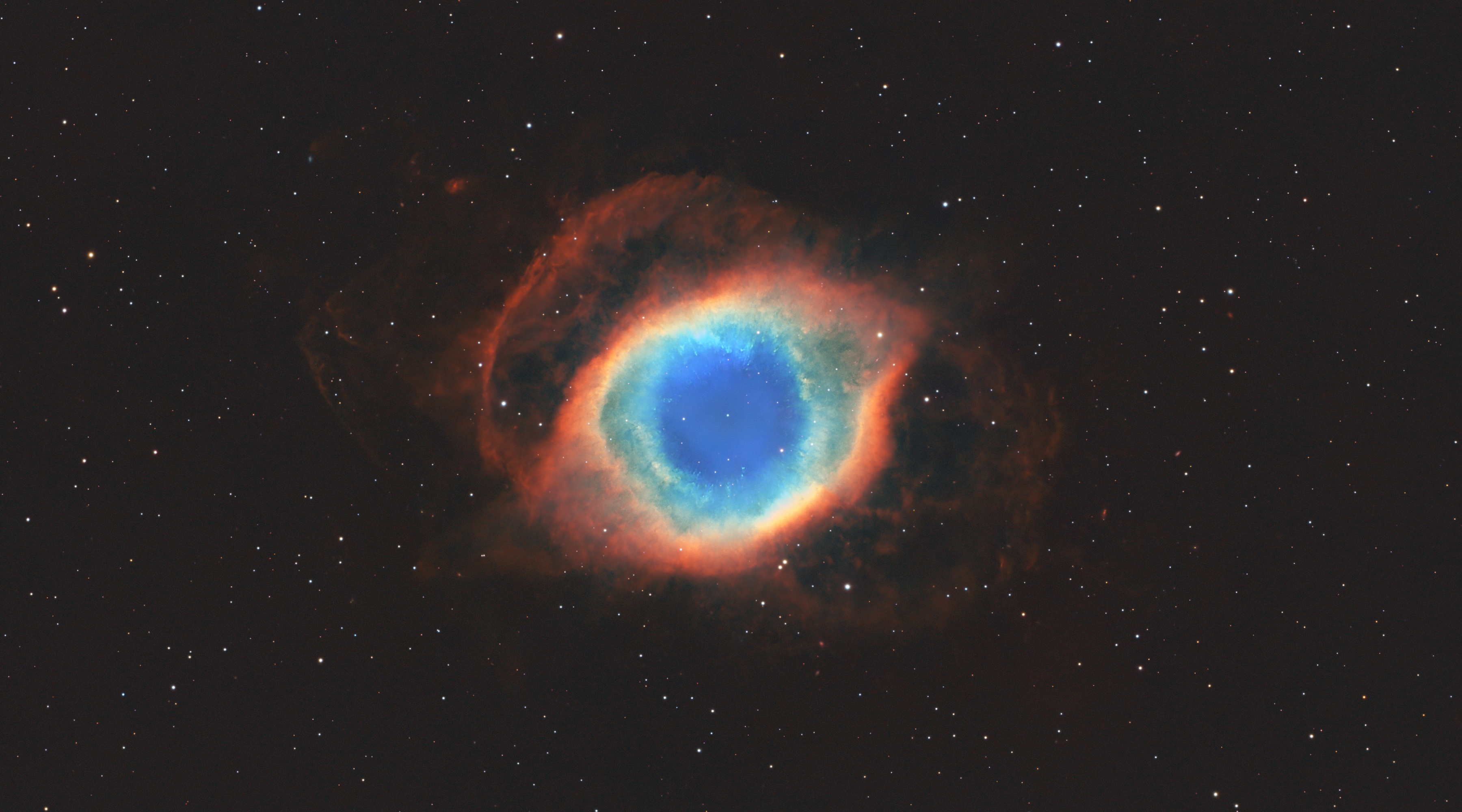
Telescope: Takahashi FSQ106ED
Camera: ZWO ASI585MM
Mount: iOptron CEM70
Exposure: 7.5 hours (28x300s Ha + 28x300s O3 + 28x300s S2 + 3x12x30s RGB)
Date: September 2025
Location: Southern Alps, France


Mooie opname!