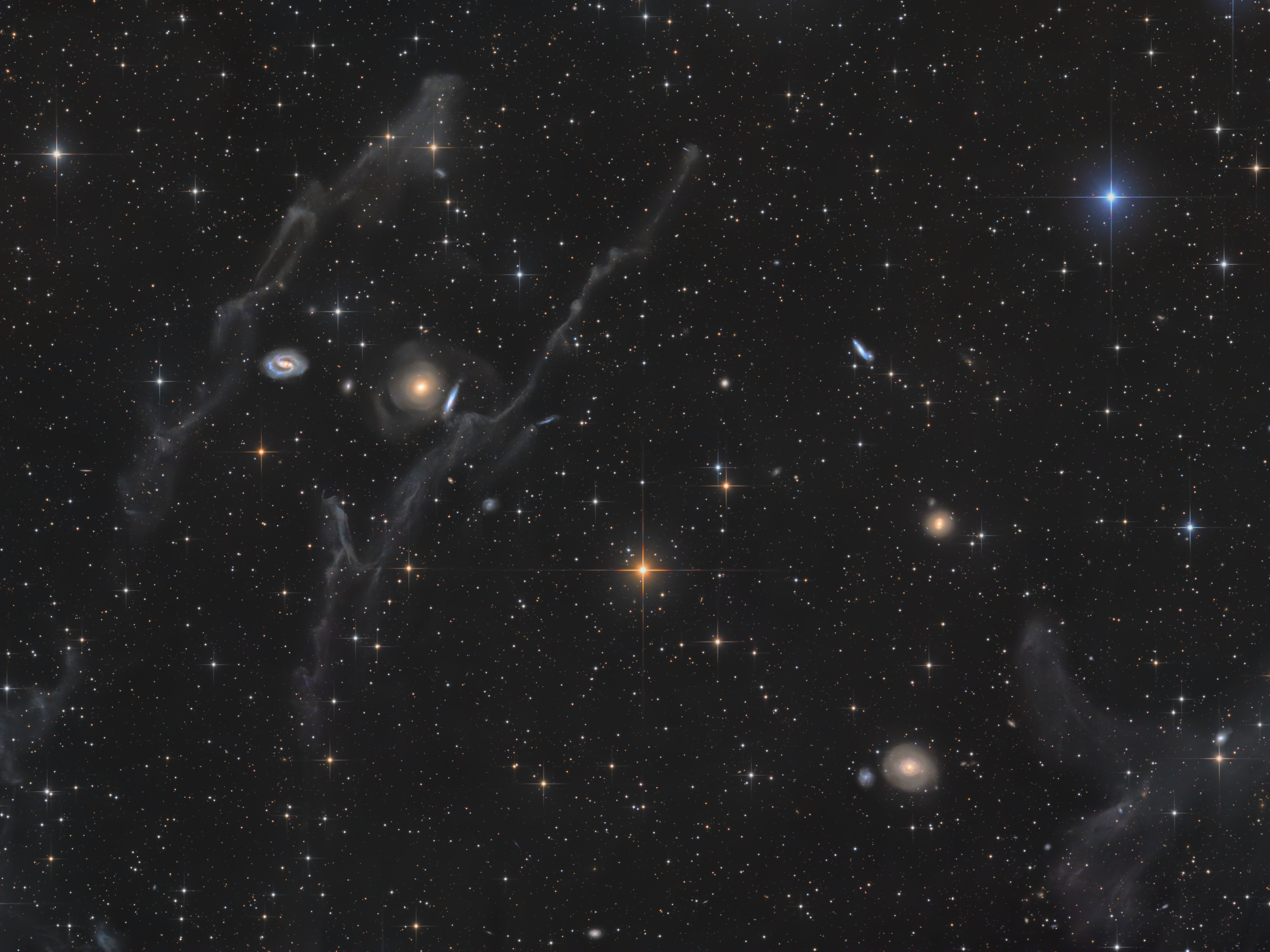
In the quiet expanse of the northern constellation Camelopardalis, the galaxies NGC 2633 and NGC 2634 are set against the ethereal backdrop of the Integrated Flux Nebula (IFN), creating a stunning cosmic tableau.
NGC 2633 is an elliptical galaxy, known for its rounded shape and population of older stars. It represents the culmination of galactic evolution, often shaped by past mergers and interactions. Nearby, NGC 2634 is a lenticular galaxy that blends characteristics of spirals and ellipticals. With a prominent central bulge with spiral arms and a faint disk, it serves as an intermediate example of galactic morphology. These galaxies, located approximately 62 million light-years away, may belong to the same group, hinting at a shared gravitational history.
Adding to their allure is the presence of the Integrated Flux Nebula (IFN), a faint and diffuse structure of interstellar dust and gas illuminated not by a single star, but by the combined light of the entire Milky Way. Unlike emission or reflection nebulae, the IFN is visible as a soft, wispy glow that drapes the night sky, particularly in regions far from the galactic plane. The juxtaposition of these galaxies against the IFN is purely coincidental. While NGC 2633 and NGC 2634 are distant and self-contained systems, the IFN resides within our galaxy, providing a local foreground to their distant light.
Another galaxy, IC 520, is located in the bottom right corner of the picture. IC 520 is a faint and relatively small galaxy. Though often overshadowed by its brighter neighbors, such as NGC 2633 and NGC 2634, IC 520 is a fascinating object that offers insights into the quieter members of the cosmic landscape. This galaxy is thought to be gravitationally linked to these nearby galaxies. IC 520’s faint luminosity and modest size suggest that it might be a dwarf galaxy, a type known for its limited star formation and lower mass compared to larger galaxies. Despite its understated presence, IC 520 plays a role in the dynamics of its local galactic group. The gravitational interplay between IC 520 and its neighboring galaxies may create subtle tidal effects that influence the shapes and motions of the trio over time.
Telescope: 16″ f3.75 Dream Scope
Camera: FLI ML16803
Mount: ASA DDM85
Exposure: 7 hours (50x300s L + 3x12x300s RGB)
Date: December 2024
Location: Southern Alps, France
 Bart Delsaert - Astrophotography
Prachtig Bart!